

Author: The FSE Engineering Team - Precision electro-mechanical assembly specialists with ITAR registration, ISO 9001:2015 certification, and IPC-A-620 compliance serving mission-critical industries for over 25 years.
Tactical deployment fields, military transit links, and rugged rail corridors subject electrical infrastructure to extreme mechanical and environmental abuse. Under these conditions, standard commercial manufacturing methods inevitably fail. Thermal cycling breaks fragile connection welds, intense vibration pulls terminals apart, and moisture entry shorts unsealed conductor runs.
Preventing these mission-critical failures requires an uncompromised approach to wire harness manufacturing. Every component choice, assembly step, and structural test must be engineered to survive harsh, real-world deployment challenges.
The Environmental Stresses of Defense Deployments
Defense and aerospace electronics must operate reliably through intense physical punishment. In theater or on heavy rail lines, equipment experiences continuous, high-amplitude vibrations that challenge every mechanical junction. Standard connectors can quickly back out of their housings, and poorly anchored wire bundles will chafe against metal chassis walls.
To withstand these harsh environments, manufacturing protocols require specialized military-spec (MIL-SPEC) circular connectors, heavy-walled overmolding, and rugged mechanical backshells. Adding strain relief components at critical transitions prevents physical stress from transferring directly to the delicate wire crimps. This design logic keeps internal electrical paths fully intact, even when subjected to intense explosive shock or severe turbulence.
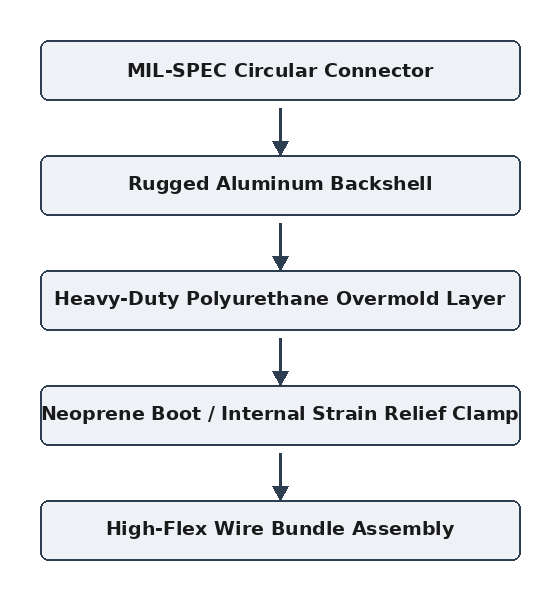
Environmental protection also requires advanced sealing methods to block moisture, salt spray, and chemical exposure. When military vehicles cross rivers or operate in coastal environments, humidity easily enters unsealed wiring. FSE addresses this challenge by incorporating environmental boot seals, chemical-resistant heat-shrink tubing, and specialized potting compounds into our wire harness manufacturing routines. These materials seal the connector interfaces completely, preventing moisture from corroding the internal pin connections.
The Class 3 Mandate: IPC-A-620 Precision
For defense applications, wire harness manufacturing is strictly governed by IPC-A-620 Class 3 criteria. This standard applies to high-performance electronic products where continuous uptime is required, and equipment downtime cannot be tolerated. Meeting these guidelines requires precise, highly repeatable production steps that leave no room for variance or human error.
A core element of Class 3 compliance is achieving a completely gas-tight crimp. Without proper tooling calibration and regular compression testing, microscopic pockets of air remain trapped inside the terminal barrel. Over time, exposure to moisture and oxygen creates internal corrosion that raises circuit resistance, drops voltage, and causes complete signal failure. Gas-tight termination processes compress the wire strands into a solid mass, creating an airtight seal that blocks environmental corrosion entirely.
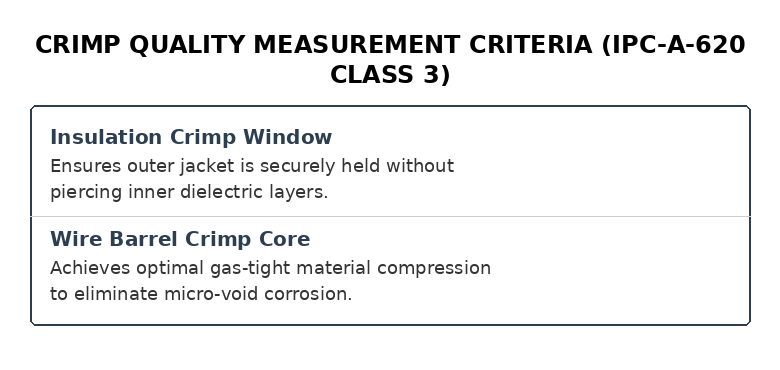
Maintaining this precision requires continuous validation of our manufacturing tooling. Automated crimping presses must use integrated crimp force monitors to analyze the displacement curve of every single strike. If a crimp deviates even slightly from the approved parameters, the press locks automatically, alerting the technician and separating the non-compliant part. This strict control eliminates human error and ensures every termination matches your exact engineering specifications.
Strict Data Protection and Security Compliance
Manufacturing hardware for defense applications requires total security control over your digital supply chain. Engineering designs and wiring layouts are highly sensitive assets that must be protected from cyber threats. Contract partners must demonstrate verifiable data security protocols before handling any defense-related project data.
First Source Electronics maintains complete compliance with both ITAR registration rules and the cybersecurity mandates of NIST 800-171. Our secure networks shield your proprietary designs, material lists, and production paths from external exposure. This structural oversight ensures your program complies with federal regulations from initial contract signing to final product shipment.
Our data security protocols cover both digital networks and physical facility access. Our manufacturing floor features controlled access zones, ensuring that only US citizens with verified clearance can view defense projects. Digital blueprints are stored on encrypted, access-restricted servers that block unauthorized file transfers. This comprehensive approach ensures that your intellectual property and critical national security assets remain fully protected.
Reshoring Production to Mitigate Geopolitical Risks
Global supply chain disruptions have highlighted the significant risks of relying on overseas component sourcing and assembly. Long transit times, shifting customs rules, and geopolitical instability can stall defense and federal manufacturing programs. Reshoring your wire harness manufacturing to a verified domestic partner eliminates these logistical risks while ensuring absolute compliance with federal purchasing rules, such as the Buy American Act.
First Source Electronics provides an established, domestic manufacturing base that streamlines your entire logistics footprint. By operating entirely within the United States, we eliminate international shipping delays and simplify communications between your engineering team and our production floor. This proximity allows for rapid prototyping, real-time design updates, and responsive production adjustments that keep your defense programs moving forward on schedule.
First Source Electronics manufactures high-reliability electro-mechanical systems and defense-grade wiring components for critical federal applications. Operating out of Elkridge, Maryland, our team leverages extensive production experience and rigorous Class 3 processes to deliver field-ready systems that never compromise on quality.
To submit your military or federal RFQ documents directly to our engineering team, please use our secure primary email portal: joel.mathew@getfse.com.
Key Takeaways
- Vibration Defenses: Incorporating MIL-SPEC backshells, rugged overmolding, and dedicated strain reliefs prevents wire fatigue in high-vibration defense environments.
- Gas-Tight Seals: Following IPC-A-620 Class 3 crimping practices eliminates internal air pockets, protecting critical connections from moisture-driven corrosion.
- Operational Protection: Fully maintaining ITAR registration and NIST 800-171 cybersecurity standards ensures complete safety for sensitive defense data.
- Uncompromising Validation: Conducting automated hi-pot and pull-force checks ensures every wire assembly is completely free of manufacturing flaws.
FAQs
What certifications does FSE maintain for defense wire harness manufacturing?
First Source Electronics is an ITAR-registered manufacturer that builds to strict IPC-A-620 Class 3 standards. Our facility maintains full compliance with NIST 800-171 cybersecurity controls to secure sensitive federal and military defense data.
Why is a gas-tight crimp required for harsh environments?
A gas-tight crimp compresses conductor strands within the terminal barrel to eliminate internal air pockets. This process blocks moisture and oxygen from entering the joint, preventing corrosion that causes voltage drops and circuit failures.
How does FSE test defense wire harness assemblies?
We run automated continuity testing, insulation resistance testing, and high-potential (hi-pot) validation on all defense builds. These rigorous processes ensure every wiring harness can withstand extreme environmental and mechanical stress without failing.
